
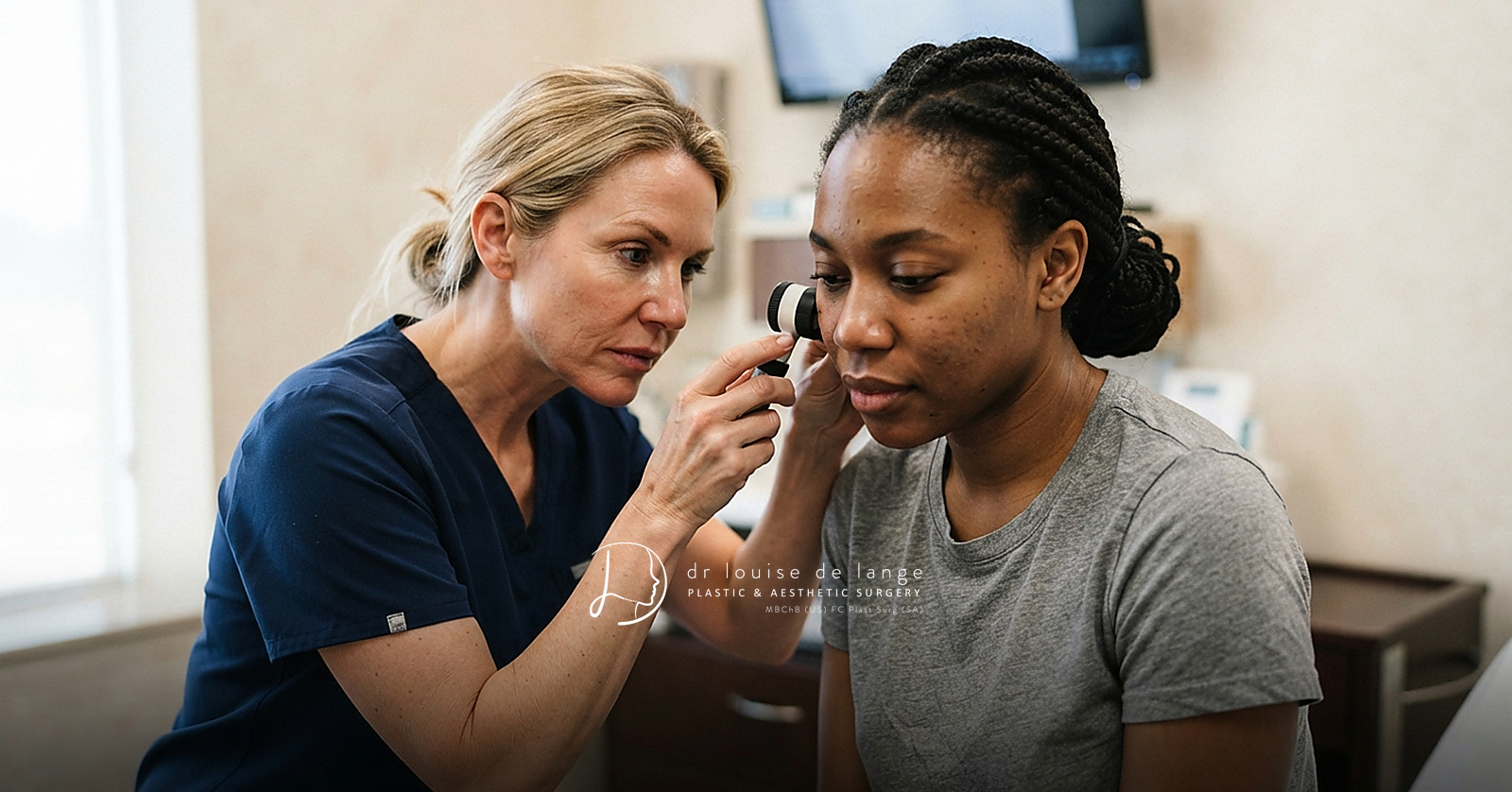
Hyperpigmentation and accumulated sun damage remain common concerns for individuals seeking a more uniform, clear, and radiant complexion. Changes in pigmentation can develop gradually and may become more noticeable with age, particularly following years of ultraviolet exposure.
Factors such as prolonged sun exposure, hormonal changes, inflammation, acne, and individual skin characteristics can contribute to persistent dark spots that do not always respond easily to standard daily treatments.
Pigmentation concerns are also rarely identical from one patient to another. Some people experience isolated sun spots, while others develop larger areas of uneven pigmentation or melasma, which can be influenced by several internal and external factors. For this reason, an individual skin assessment is important before deciding on the most appropriate treatment strategy.
The Melanopro Peel offers a targeted professional protocol designed to address stubborn discoloration while helping to improve skin tone and texture. Rather than being limited to a single treatment performed in the clinic, Melanopro combines professional treatment with a structured homecare programme.
Understanding how this clinical treatment works, who it may be suitable for, and what to expect during recovery can help patients make more informed decisions about their skin health.
Understanding Melanopro and Its Clinical Protocol
The Melanopro protocol is designed as a multi-stage approach rather than an isolated peel. Pigmentation can be complex, and treating only what is visible on the surface may not always be sufficient. A structured protocol therefore allows the skin to be prepared before treatment and cared for consistently afterwards.
The process combines skin preparation, an in-clinic treatment and six weeks of targeted homecare, creating continuity between professional treatment and daily skincare.
Preparing the Skin Before Treatment
The Melanopro protocol begins prior to any in-clinic application. It starts with a dedicated pre-conditioning phase to prepare the skin using specific products recommended by the practitioner.
This step should not be considered optional preparation. Pre-conditioning helps ensure that the skin is ready for the active treatment and may help reduce the likelihood of excessive irritation and post-inflammatory hyperpigmentation.
It also provides an opportunity for the practitioner to evaluate how the skin responds to the prescribed products before proceeding with the complete protocol.
During this stage, patients should follow the recommended routine carefully and avoid introducing additional active ingredients without professional advice. Using too many exfoliating or potentially irritating products simultaneously can compromise the skin barrier and interfere with the treatment plan.
The In-Clinic Melanopro Treatment
Following the preparation period, the next stage consists of an approximately 60-minute in-clinic treatment.
The professional application is designed to target areas of pigmentation while supporting a more even-looking complexion. Because pigmentation patterns vary considerably, the consultation and skin analysis preceding treatment remain particularly important.
The practitioner can assess the distribution and appearance of pigmentation and determine whether Melanopro represents an appropriate approach for the individual patient.
The in-clinic appointment is only the beginning of the complete protocol. After this stage, responsibility for maintaining the treatment programme shifts partly to the patient through a carefully structured homecare routine.
Six Weeks of Targeted Homecare
Following the professional treatment, patients continue with a six-week homecare phase involving the daily application of specific products.
Consistency is particularly important during this period. Pigmentation treatments generally work progressively, meaning that patients should not expect the final result immediately after leaving the clinic.
The homecare phase is intended to support the professional treatment while continuing to address uneven pigmentation over the following weeks. Patients should use products exactly as instructed and avoid increasing the frequency or quantity in an attempt to accelerate results.
More aggressive application does not necessarily produce faster improvement and may instead increase irritation.
Why Hyperpigmentation Can Be Difficult to Treat
Hyperpigmentation occurs when certain areas of the skin contain an increased concentration of melanin, the pigment responsible for skin colour. The causes behind this increase can vary significantly, which is one reason pigmentation concerns can sometimes be persistent.
Understanding the origin of pigmentation is therefore an important part of choosing an appropriate treatment.
Sun-Induced Pigmentation
Repeated exposure to ultraviolet radiation can stimulate melanin production and contribute to visible changes such as sun spots and uneven pigmentation.
These changes may develop slowly over many years, particularly on frequently exposed areas such as the face. Even when existing pigmentation is treated successfully, continued UV exposure can contribute to its recurrence or the development of new areas of discoloration.
For this reason, pigmentation management should always be accompanied by consistent broad-spectrum sun protection.
Melasma and Hormonal Pigmentation
Melasma typically appears as symmetrical patches of brown or grey-brown pigmentation, commonly affecting areas such as the cheeks, forehead, upper lip, and chin.
Unlike a simple isolated sun spot, melasma can have multiple contributing factors. Hormonal influences, genetic predisposition, sun exposure, and other triggers may all play a role.
Because melasma has a tendency to recur, treatment is generally focused not only on improving existing pigmentation but also on managing the factors that may stimulate its return.
Post-Inflammatory Hyperpigmentation
Pigmentation may also develop following inflammation or injury to the skin. This is known as post-inflammatory hyperpigmentation (PIH) and can occur after acne lesions, irritation, or certain skin treatments.
The affected area may remain darker even after the original inflammation has resolved. Careful treatment selection is particularly important in these situations because excessive irritation can potentially stimulate further pigmentation.
Candidate Profiles and Addressed Concerns
Melanopro is formulated to benefit patients presenting with environmental skin damage, dark spots, melasma, hyperpigmentation, and uneven skin texture.
Clinically, it is considered suitable for individuals with Fitzpatrick skin types I to IV. The Fitzpatrick scale is commonly used to classify skin according to its response to ultraviolet exposure, and understanding a patient’s skin type can help practitioners assess treatment suitability and potential pigmentation risks.
What Concerns Can Melanopro Address?
Patients may consider the protocol when they are concerned about:
- Sun spots and accumulated photodamage
- Age-related pigmentation
- Acne-related pigmentation
- Hormonal melasma
- Uneven skin tone
- Persistent dullness
- Areas of visible discoloration
- Uneven skin texture
However, the presence of pigmentation alone does not automatically mean that Melanopro is appropriate. A professional consultation allows the practitioner to distinguish between different pigmentation patterns and evaluate the condition of the skin before treatment.
Downtime, Safety, and What to Expect After Treatment
Recovery is an important consideration when choosing any professional skin treatment. Patients increasingly seek procedures capable of producing visible improvements without requiring extended periods away from work or social activities.
Unlike some intensive skin treatments, the Melanopro Peel is not associated with extreme flaking or significant social downtime. This can make the protocol particularly attractive to patients who want to address pigmentation while maintaining their normal routine.
Nevertheless, limited downtime does not mean that aftercare can be ignored.
Skin Changes During the Treatment Period
The skin may undergo changes as it responds to the active ingredients used throughout the protocol. Individual experiences can vary depending on skin sensitivity, pigmentation type, existing skincare routines, and adherence to aftercare instructions.
Patients should therefore follow the recommended skincare programme closely and contact their practitioner if they experience unexpected or persistent reactions.
In general, chemical peel procedures as a category can carry risks including scarring, abnormal healing, skin blotchiness, cold sore eruptions, changes in pigmentation, increased sun sensitivity, dryness, peeling, and small whiteheads. The specific risk profile varies according to the type and strength of the treatment as well as individual patient factors.
A detailed consultation and appropriate skin preparation help practitioners determine whether a particular peel or depigmentation protocol is suitable.
The Importance of Sun Protection After Melanopro
Sun protection is one of the most important components of pigmentation management, both during treatment and after the protocol has been completed.
UV exposure can stimulate melanocytes and contribute to renewed pigment production. Treating existing pigmentation without addressing ongoing sun exposure can therefore limit the longevity of the result.
Patients should use appropriate broad-spectrum sunscreen consistently and follow their practitioner’s recommendations regarding direct sun exposure. Protective clothing, hats, shade, and sensible sun habits can provide additional protection.
Sun protection should not be viewed solely as temporary post-treatment care. For patients prone to hyperpigmentation or melasma, it becomes an important part of their long-term skincare strategy.
When Will You See Results From Melanopro?
Pigmentation treatments generally require patience. While some changes may become noticeable during the protocol, the skin can continue to evolve after treatment has been completed.
Improvements following the Melanopro protocol may continue for weeks or even months after the final product application. This progressive process is important to understand when evaluating results.
Rather than focusing exclusively on individual dark spots, patients may notice broader changes in the appearance of their complexion, including a more uniform tone, improved luminosity, and refined-looking skin texture.
The degree of improvement varies according to the type and depth of pigmentation, individual skin characteristics, environmental exposure, and adherence to the recommended homecare programme.
Maintaining Results Over Time
Completing the six-week Melanopro protocol does not mean that pigmentation can no longer return. Hyperpigmentation can be influenced by ongoing environmental and biological factors, particularly UV exposure and hormonal changes.
Long-term maintenance therefore matters.
A consistent skincare routine, appropriate sun protection, and periodic professional skin assessments can help preserve improvements and identify new pigmentation concerns early.
Patients should also avoid treating recurring pigmentation independently with increasingly aggressive products. If discoloration begins to return, reassessment by a qualified practitioner can help determine the most appropriate next step.
A Personalised Approach to Pigmentation Treatment
No two cases of hyperpigmentation are exactly alike. The visible colour of a dark spot represents only one aspect of the condition; its cause, depth, distribution, duration, and the patient’s skin type all influence how it should be managed.
This is why a professional consultation remains central to the Melanopro protocol.
A personalised assessment allows Dr. de Lange and her clinical team to examine the skin, discuss previous treatments and skincare routines, identify relevant triggers, and establish realistic expectations before recommending treatment.
For patients affected by persistent pigmentation, sun damage, melasma, or uneven skin tone, a structured approach combining professional treatment, targeted homecare, and long-term sun protection may provide a more comprehensive strategy than relying on isolated skincare products alone.
Book a consultation with Dr. de Lange to evaluate your skin type, discuss your pigmentation concerns, and determine whether the Melanopro protocol is appropriate for your individual clinical needs.
